March 9 Resupply itinerary

March 9th, 2010

“March madness” is in full swing for us right now, but it isn’t basketball!    It’s our Awana Club involvement, with THREE big weekend events back-to-back.   By the time this is over, all the kids in our club, from the kindergarteners through the high schoolers, will have had a chance to compete with kids from other clubs both in the North Bay Area as well as all of northern California/Nevada.   So far we are doing VERY well, and I’m proud of our kids and how hard they have worked.  One of the great features of Awana is that NOTHING is ever just given to you.   Kids have to EARN every “perk”, every award, every privilege.  And once they catch on (and even more importantly, their PARENTS catch on!), they jump in with enthusiasm. 

Meanwhile, we are doing about 40 miles a week of hiking with packs over all sorts of terrain.  I am very pleased to see my feet are responding and starting to get tougher.   By the end of the PCT in 2005, I had unbelievably tough skin, especially on the balls of my feet.  When we were training in 2005, I kept getting blisters, and I actually began the trail at Campo carrying various “blister protection devices.”  But after awhile, I sent them all home, because I didn’t need them anymore.  In the entire time we were on the PCT, I only got two very small blisters, and they were easily fixed.   This time I do not expect to get any blisters.

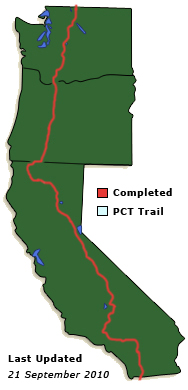
White Beard and I have also been hashing out our resupply itinerary.  This has taken some discussion!!!  But here is what we’ve decided (I’ll list the locations and try to explain WHY we chose these and not some of the other ones)….

(One basic principle that guided us was “We hate hitch-hiking!”)

1) We plan to drive a rental car to San Diego, then take trolley & bus to Campo.  We will camp at Campo, then hike the PCT to Lake Morena the next day, which will probably be the Friday of the ADZPCTKO weekend.

2) We will attend ADZPCTKO till after dinner on Saturday, then head out.

3) WARNER SPRINGS will be the next stop.  We will skip Mt.Laguna (went to it in 2005,  and it’s really cute and pretty, but this time we’d rather just keep hiking).   We plan to enjoy the amenities at Warner this time–last time it was just a quick overnight stop.

4) PARADISE CAFE–we will stop and get our resupply box here rather than in Idylwild.  Getting to Idylwild is a pain.  You have to either hitch-hike or walk 4 miles down the Devil’s Slide trail, then another goodly ways into town.  Last time we were there,  we found the place was very pretty and the people very nice, but all places we could stay were totally full and we couldn’t even camp at the campgrounds, because they were all full, too.  We don’t want a rerun of that experience.

5) BIG BEAR CITY–This is one place we WILL hitch-hike to. Last time, we walked down Van Dusen Canyon Road.  Nobody would give us a ride, and it was pretty discouraging.  Finally, not too long before town, a couple gave us a ride on the back of their hay trailer.  But we’d already been passed up by so many cars that we vowed we’d never try Van Dusen again.   This time we will try hitching at the highway.  Other thruhikers have told us that they didn’t have much trouble hitching from there.   As to where to stay, last time we stayed with a trail angel we met at the post office.   Not sure where we will stay this time.

6) CAJON PASS–We resupply here rather than Wrightwood because getting to Wrightwood is a pain.  Last time we did the PCT, the trail to Wrightwood was totally covered with snow and there was a sign warning that it was dangerously icy and slippery, and to hitch-hike in at the highway instead.  Fortunately, we had already resupplied at Cajon Pass, so we didn’t care.  We have been to Wrightwood, and it is very cute and pretty, but we stick with Cajon because it’s right on the trail and it has TRAINS!   We love to watch trains, and there are plenty to watch at Cajon.

7) AGUA DULCE–Hiker Heaven!!!  We plan to take our first zero here,  to be able to relax for a day and hang out with all the other hikers.  Also, it’s a good place to get reports on what’s happening in the Sierras.

8)(Tentative–we are trying to find out if the place is still open) GIL’S COUNTRY STORE . We stopped here last time and had a blast.  Besides picking up our box, we enjoyed good food and fun conversations with the locals–and since they LIVE in the Mojave Desert, they are definitely “interesting” folks!

9) TEHACHAPI–This is an unavoidable hitch-hike, but worth going to.  It’s a very pretty place, with lots of trains going through.  We stayed at a motel that was very hiker-friendly.  The only downside to Tehachapi is that it’s very spread out.  The grocery store is WAY off in one direction and the post office is WAY off in the other direction.   Once you get to Tehachapi, there is a trail register that lists trail angels who will drive you back to the PCT.

10) KENNEDY MEADOWS–we really enjoyed our “nero” here in 2005, and left with clean clothes, clean selves, and HEEEEEAVY packs ready for the High Sierras. 

11) VERMILION VALLEY RESORT–Last time, we had a “nero” here. This time, depending on how tired we are and how low on food, we may either not stop at all, or we will just stop off and eat, scrounge through the hiker barrels, and then be on our way.   I guess you can say it will be more of a “pit stop” than a resupply.   We do not plan to send a box here this time (we did in 2005).

12) MAMMOTH LAKES–We plan to zero here, after leaving the PCT at Red’s Meadow.   We figure we will be pretty tired and hungry at this point!   We didn’t stop here in 2005, since we had already nero’ed  at VVR.

13) TUOLEMNE MEADOWS–This is where we hope and pray that the post office is open!!   If it isn’t, we’ll have to go all the way down to Yosemite Valley to get our box.   In 2005, we arrived here around lunchtime and by the time we finished eating, sorting out the stuff from our box, etc. it was late afternoon.  Knowing the “bear situation” in Yosemite, we opted to stay the night with our food safely stowed in a bear BOX at the campground before leaving early next morning.

14) ECHO LAKE–This is a very pretty place. Last time we hitched down to South Lake Tahoe from here.   This time, we will just stop and eat and get our box and go.

15) POOH CORNER–We have never been to the Person’s place at Donner Lake, and it sounded great, so this time we decided we’d check it out!

16) SIERRA CITY–A wonderful town; a bit of a detour off the trail, but well worth it.   The restaurants in Sierra City are AWESOME, and the people are very friendly to hikers.   You can camp by the church lawn for free.  (Don’t camp ON the lawn, or you’ll get well-watered when the sprinklers come on at midnight!)

17) BELDEN–Last time, we picked up our box at the post office, and that was kind of an “experience”.  But this time we are going to try Little Haven.

18) OLD STATION–The postmistress here will phone Georgi Heitman when you pick up your box, and next thing you know, you are in another “hiker heaven” with the Heitmans!  We had planned to just pick up our box and keep going in 2005, but we met so many people who said, “You HAVE to stay with Dennis and Georgi” that we  reconsidered.  And we are glad we did!

19) BURNEY FALLS STATE PARK–We don’t plan to stay here, just pick up our box and go.   But the staff are very friendly and helpful to hikers!

20) CASTELLA (AMMIRATI’S MARKET)–Last time, we picked up at the post office.  Glad the store takes boxes now!   We bought a bunch of  food at the store and took it over to the State Park next door, where we spent the night and got all cleaned up and had a great meal. 

21) ETNA–In 2005, we were not planning to go to Etna, but a snowstorm forced us down off the trail.  We ended up staying at the Hiker Hut, and enjoyed fantastic food in town till the storm had died down enough for us to return to the PCT.   This time, we are PLANNING to go to Etna!   Superfriendly town, supernice people!

22) SEIAD VALLEY–How can any thruhiker bypass a chance at the famous pancakes here?  White Beard and I were very conservative, and ordered ONE pancake each.   We could barely finish them!   You can camp at the RV park next door.  We didn’t stay at Seiad–just picked up our box, ate a pancake & milkshake and headed on.

23) HYATT LAKE RESORT–We bypass Ashland; it’s too much of a hassle to get there, and we’ve been to Ashland before anyway, many times, so it’s “no big deal” to us.   Instead, we go straight to Hyatt Lake, where you can get a shower,  food and friendly conversation.  We even got to spend the night for free, in the campground.

24) CRATER LAKE (MAZAMA VILLAGE)–We plan to pick up our box at the Mazama Village Store instead of the post office.  ( Getting to the post office is a major pain.)  The Village has everything a thruhiker could want–resupply, laundry, showers, an all-you-can-eat buffet, and a campground (even cabins, if you want to be more civilized).

25) SHELTER COVE RESORT–This is a very pretty, friendly place.  You can get your box, go for a swim, eat, etc.   For us in 2005 and again in 2010, it will be a “pit stop”, not even a nero.   We try to buy enough stuff at the store to make them glad they held our box for us!

26) BIG LAKE YOUTH CAMP–This place is beautiful!   We hung out at the beach and relaxed for a whole day.  For very little money you get big, delicious vegetarian meals, plus free laundry.  If there’s room, you can stay in a cabin–if not, you go off and camp in the woods by the lake.   We love it here, because we like to hang out with Christian folks.   Fear not–if you come here,  nobody will “bug you about religion”–they will just do their best to be helpful and kind in every way they can..

27) TIMBERLINE LODGE–for us, this is a “pit stop” where we just get our box, eat, and go.   But it is a really fun place!

28) CASCADE LOCKS–We plan to take a zero here, in order to visit with family from Portland.  There are some really good restaurants here.

29) STABLER’S COUNTRY STORE–We didn’t stop here in 2005, since it’s only a day and a half into the trail, but we have learned that in Washington State, you are in RUGGED hiking, and anything you can do to save weight in your pack is good.  Stabler’s is only a half mile off the trail.

30)WHITE PASS (KRACKER BARREL)–We stopped here in 2005, and ate and ate and ate.  They also have a laundry, but no showers.  We washed our clothes, then decided it would be nice to take a break, so hitched into Packwood for the night.  Next day, it was a nightmare trying to get back to the PCT.   So this time, we will just resupply, eat, wash clothes and head out.

31) SNOQUALMIE PASS (SUMMIT INN)–Last time, we sent our box to the post office.  Not good.   The post office is a closet in the gas station, and it’s only open for 2 hours a day.  So we are sending our box to the Summit Inn this time.   Snoqualmie has a great restaurant, and it’s a good place to rest up for a night before tackling the next tough part of the trail.

32) STEHEKIN–Notice that we didn’t schedule Skykomish as a resupply.  We didn’t plan on going there in 2005, either, but ended up making the trip down the hill because we needed more food, and we were very tired.   The Dinsmores have moved, and are now 24 miles from the PCT, so you have to hitch-hike to and from their house.    We do not plan to try that again unless we are desperate.   So we will just tackle the long, long hike from Snoqualmie all the way to Stehekin.   Once in Stehekin, you have options.   Last time, we stayed at the Ranch owned by the Courtneys.  It’s not cheap, but it was awesome!  This time, we have not decided where to stay in Stehekin.  We love the beauty of Lake Chelan, so staying in town is very appealing.

33)  MANNING PARK–We come in here to wash up, change clothes, eat a bit, and catch the bus for Abbottsford.   From Abbottsford, we walk back into the USA.

February 28 The mental challenge of the trail

February 28th, 2010

Well, I’m at “One down and two to go!”  I just got back from California’s capital, Sacramento, where I spent two days with a team of junior high kids from our Awana Club–they were competing with teams from all over northern California and Nevada.  Next weekend it’s a more local competition (only northern San Francisco Bay Area) with the 3rd-6th graders, then the last weekend back to Sacramento again for the high school level competitions.

Our junior high kids were totally AWESOME!  They have worked so hard, and they left every other team “in the dust” in the Bible knowledge competition, then went on to a solid 3rd place in the Games.  It is a wonderful thing to see hundreds of junior high kids all gathered together and so focused and so determined.   They’ve learned through Awana training how to have a good attitude in all circumstances, be good sports and live to honor God in everything they do.  I love these kids, because I can still vividly remember being a junior higher myself, and the incredible challenges of being that age and making decisions that will literally impact the rest of your life. 

No kidding that attitude is important!   And one place where I think I can almost say “Attitude is everything” is thruhiking the PCT.  When Bill White Beard and I did the PCT in 2005, we were amazed at some of the attitudes we encountered in other hikers.   And by the end of the trail, I think it’s safe to say that our conclusion was, “If you need to be all jazzed/pumped up/motivated to do something, then you won’t finish the PCT;  if you are inclined to pityparties and want “time for ME”, you won’t finish the PCT; if you depend on other people being WITH you to keep you motivated, you probably won’t finish the PCT (unless you are lucky enough to find a buddy);  if you are easily demotivated by difficult circumstances, you won’t finish the PCT……well, you get my drift!

We were amazed at how many people who started at Campo vowing, “Canada, here I come!” had quit by Warner Springs (only 100 + miles into the trail) and a bunch more quit at Idylwild.  Others quit at Horseshoe Meadows or Tuolemne Meadows.   One lady I talked to (who ended up quitting at Idylwild) said to me, close to tears, “I thought I was ready for this trail.  I really trained.  But this is way tougher than I thought.”   We were sitting by the trail up on the Desert Divide at the time; it was horribly hot and we were very short on water (my husband Bill and her husband had gone down to Apache Spring to get water–we weren’t even having to make that steep, rough scramble down to the spring, then the steep, hot climb back up; we got to sit in the bit of shade of some bushes and commiserate, while our gallant husbands took on the REALLY tough stuff).  I tried to encourage her with “It’ll be OK–pretty soon the trail will level out, the sun will be lower and it will be cooler,” but she was too far gone in misery to be encouraged.

Two years ago, a hot, drought-stricken, forest fire year in California,  Bill and I were in Horseshoe Meadows acclimating for climbing Mt. Whitney.  It was Ray Day, June 15, and there were a lot of  PCT thruhikers taking a break from the trail by coming down from Trail Pass, then returning by way of  Cottonwood Pass.   I have to say,  it was a depressing experience.  Many of the hikers were in pityparty mode, and I heard that later, many quit.  they complained of the heat, the fires, the lack of water, of being dirty for days on end.  They were taking every opportunity to slackpack or even totally skip parts of the PCT if they got a chance.   When you get into that kind of mentality,  your days as a thruhiker are definitely numbered.

We noticed that the people who FINISH and make it to Canada are the ones who are steady, determined, generally cheerful, able to “pick themselves up” if they become discouraged, and are not overwhelmed by what Ray Jardine called “the avalanche of adversity”.  I myself had days when we did the PCT when I was desperately tired, horribly hot or cold, being driven nuts by hordes of mosquitoes, dealing with very sore shoulders, or being terrified by a river crossing or trail-on-the-edge-of-a-cliff.   There were times I had to ask Bill to wait a few minutes so I could sit down and cry.  Then I would pull myself together, hoist pack, and head on, still sniffling a bit, till I was OK again.   Bill had his own issues to deal with–awful blisters, plantar fasciitis, stomach troubles, etc.   But we kept going, knowing that eventually whatever the problem was, we would (with God’s help, many times) figure out a solution, and all would be OK.

One of the reasons I encourage people to have a disciplined training program (which I described back on January 1) is because you are not just toughening your feet and legs and shoulders for the trail–you are also toughening your ability to keep on hiking no matter what.   So far this year, since we started training,  it’s pretty much been in the rain and mud and cold every time we went out.  But that’s good!   It helps build our MENTAL strength for the trail.  Back in 2005,  we had no idea how to really train; I remember one day we spent in Sugarloaf State Park carrying our packs up and down every hill in the place.  By the end of the day we were totally worn out.   I remember sitting exhausted by the side of a trail in the late afternoon and saying to Bill, “The PCT could not possibly be as tough as this.”   Hah!   The PCT was WAY tougher!! 

But the PCT is also a trail where every single day brings a new adventure (some wonderful, some scary, some beautiful, some challenging) and that’s what often kept Bill and I going.   We’d get up in the dark early in the morning, when it was cold, and be saying to each other, “Well, I wonder what the adventure will be today?”   Once it was barely light enough to see the trail (and sometimes, in the desert, while it was still dark), we’d hoist packs, and hug each other and pray, “Lord, walk with us today,” and off we would go, genuinely looking forward to whatever the day might bring.

And it always brought something wonderful, because the PCT is one incredible trail!

February 18 Coding your guidebook

February 18th, 2010

A couple of days ago, we had our FIRST day since DECEMBER when we weren’t hiking either IN the rain, or with a THREAT of rain!  Wow!  No need to carry raingear!  No need to carry thermoses of hot drinks!  And both Bill and I were feeling much better after fighting off whatever the latest “cough thing” that’s going around.  So off we went to another of our favorite places to hike–Jack London State Park, near Sonoma, CA.   The park is basically the property that used to be Jack London’s “Beauty Ranch” and it well deserves its name.  It has a mountain to climb, with superb views at the top (including all the way to San Franciso–Jack London rode up here on the morning of the great earthquake in April, 1906, and could see the smoke coming off all the terrible fires in “The City”)   and there are lakes,  magnificent oak trees and grassland WITH NO WILD PIGS to mess it up, plus the latest round of spring wildflowers putting in an appearance.    And if you have time, you can visit the ruins of the Wolf House, or poke around in The Cottage or in the House of Happy Walls.  It’s a great place!

I am still up to my eyeballs coaching kids at Awana club–the first big competition is the weekend of Feb. 26-27, then another on the following weekend, March 6, and finally the last one on the weekend after that, March 12-13.   At that point, I may collapse for a day??? and then leap into SERIOUSLY preparing for the PCT, starting with collecting boxes to mail ourselves resupply packages.

But every day I take 15 or 20 minutes to do what I call GUIDEBOOK CODING.  It saved us TONS of time and frustration on the trail when we were consulting maps and trying to figure out where we were.

We use the good ol’ Jeffrey Schaffer/Wilderness Press guidebooks, and carefully take them apart so that we only need to deal with a few pages at a time–just enough to get us to the next resupply point.   I know there are some new guides out there, but we have not had a chance to really LOOK at them and decide if they are OK.  So we are sticking with the tried and true.

The problem with the Schaffer books is that the TEXT which describes the trail is often not on the same page with the corresponding MAP.   And once you manage to coordinate the two, then you have the “fun” of trying to figure out exactly where you are.  When you are on the trail and it’s raining or it’s ghastly hot, or you are very tired, or the sun is about to go down, or whatever, trying to deal with this is a major pain.  So I came up with a simple coding system that makes it possible to instantly coordinate map and text and know where you are.

First off, at the top of EVERY column of text, I write the number of the map that goes with it.  For example, if you are in Section K, and the column of text corresponds to map K4,  I write “K4″ at the top of that column.  If the map number changes partway down the column, I draw a very black line across the column at the point where the map changes, and put the new map number next to the line.

Then I add what I call “guide posts.”   I study the map and text carefully and on the map I CIRCLE trail junctions, landscape features, etc. and assign each a number, which I write next to them on the map.   Then I study the text to locate exactly where in the text that trail junction or landmark is mentioned.  I underline it and write its corresponding “guidepost number” next to it.

Yes, that’s a fair amount of work, but on the trail, oh man, did it save us time and grief!   I would hate to think of the frustration of not having a pre-coded guidebook.   And what’s fun about doing it is that it’s kind of like “virtual hiking”.   I enjoy thinking about the things along that part of the trail.   OK, this is easy for me, since I have ALREADY HIKED the trail, so I have a mental picture to draw on, but even the first time,  it was still fun to do.   I highly recommend coding your guidebook, whichever one you use!

February 9 Cooking & eating

February 9th, 2010

Bill “White Beard” and I spent today hiking around Lake Sonoma, which is a huge reservoir where our city of Petaluma gets a lot of its water.  For the past several winters, we’ve been a bit short on rain, so the lake never really got full, but wow, it is now!  The steelhead are running in the river that comes out of the dam, but we didn’t stop to watch–we wanted to get on the trail!  Both of us are fighting off some sort of cold (snuffly noses, scratchy throats) but we loaded up our packs and went anyway–the only difference is we didn’t walk as fast, and we took a whole hour to eat lunch.

It was a muddy trail, as we expected, and there was one tricky creek crossing where (sigh) I had to cross on a couple of logs.  Bill zips across logs–I am a “chicken maximus”.  Once I got across the creek, I had to climb well up on a steep hillside to avoid using a very narrow slippery trail on the edge of a cliff, which would have taken me back to the “main trail” very quickly, but I was too chicken to follow it.  But my scrambling up the hill had a couple of dividends–I found a two-point antler AND a wild pig jawbone.  

And the wild pigs certainly are to be found in abundance around Lake Sonoma!  The trail is sometimes hard to follow because they have plowed it up so much, and sometimes they make a wallow right in the middle of the trail.   The pigs are really elusive, though–rarely do you SEE any.  We certainly saw none today, though we came upon what was obviously VERY freshly plowed up ground.  Because of the pigs, instead of green meadowy ground under lovely big oak trees, what you get is rough ‘n tumble, muddy dirt, all worked over by the pigs.   The backpack and boat-in campsites all have tall poles for hanging your food so the pigs don’t get it.

Personally, I’m cheering for the hunters!   Every now and then, the rangers let them have a go at pig hunting.  Wish they’d do it more often; I hate to see whole hillsides all brown and muddy instead of green and full of wildflowers.

Well, to switch to the subject of cooking on the PCT…..   Some thruhikers cook.   Some don’t.   We are in the “cook-once-a-day” category.  We find that having a hot meal really makes a difference. It feels homey and comfortable.   But since we don’t want any bears and critters visiting us in the night, we cook in the MIDDLE of the day, around noon, unless it is really ghastly hot, in which case we wait till things cool down a bit, say around 5:30 pm, cook then, and make as many miles after that as we can before we camp.

Our system is that somewhere around noon (preferably near a water source, if possible) we stop to eat.   First order of business is to find a place to set up the stove, where there is ABSOLUTELY NO CHANCE of starting a grass or forest fire.  We look for flat rocks, bare dirt, whatever we can find.  Sometimes we will even CARRY a nice “cooking rock” over to where we want to cook and eat.   Once that’s done, I set up the “kitchen” while Bill airs sleeping bags.    I cook, we eat, then Bill “washes” the dishes (which we have pretty much licked clean, so there isn’t much to do!).   Then we pack up and hit the trail again.  The whole process takes 40-60 minutes, depending on how much of a hurry we’re in.

Our “kitchen” is an alcohol stove made from the bottom of a beer can.  We have a small pot rack for the pot to sit on above the stove, and we have a small titanium pot with folding handles.    We each have a plastic cup and spoon.   Some thruhikers just eat straight from the pot, but with two of us, it’s easier to divvy things up if we have the cups. 

Here’s our basic food plan:

First thing in the morning  (usually 5:30 am) as we hit the trail:  I eat a Larabar, while Bill snacks on jerky or some other bar.

Around 7:30ish, it’s  breakfast:  Granola with freezedried fruit, nuts & seeds, powdered milk.  We vary the type of granola, fruit & nuts.

Around 10:30,  we stop for 10-15 min. for a Snickers each.

Around noon, we cook.   I have a “base” of either instant mashed potatoes or stovetop stuffing mix or instant rice or freezedries, to which I add freezedried veges and meats, or a package of tuna if we are getting close to a resupply.   Once you open a tuna packet, it gets REALLY SMELLY really fast, even if you try to rinse it out, so I saved the tuna till almost the end of each section.  We usually also eat a cookie of some sort, and we each also drink a cupful of Emergen-C, and take some vitamins.

Around 3:30, we stop for 10 minutes and have another Snickers.

Around 5:30 or 6:00, we stop for supper–crackers and cheese or peanut butter; dried fruit; nuts.   We might have plain water or might add some Crystallite.  Sometimes I toss in something from town, if we have just come out of a resupply.   Some of the nicest suppers we had on the PCT were when trail angels gave us fresh veges or fruit.  At Ebbett’s Pass, the visitor center people LOVE thruhikers.   They keep fresh fruit in the refrigerator for us.   When we came through, they gave us a HUGE canteloupe, which was a great addition to peanut butter and crackers!   Another time, we were almost to Burney Falls when we went past a PG & E place, and the guys there gave us fresh tomatoes and cucumbers!   Wow!   Peanut butter and crackers with tomatoes and cukes! 

The last comment I have about food is–when you are in town, eat LOTS of high calorie food!   When we did the trail in 2005, we were trying to be all virtuous and only eat healthy food, especially NO candy!   The result was that after two months of hiking, we were both starving hungry all the time.  Bill lost a lot of weight and began to lose strength, too.  Finally, at a resupply, I was talking to fellow thruhiker Pika and told him of our troubles.   He said, “You need Snickers.”   He explained that we seriously needed to start getting caught up on our calorie deficit.  We took his advice, and boy, did it make a difference!   We started eating Snickers,  and in town we ate as much as we could.   I started bringing cookies on the trail, and more cheese, etc.   It really helped. 

So beware of calorie deficit!   Mangia, mangia!  as my Italian neighbors used to say whenever we were at their house.  Eat!   Eat!

February 6 Drinking water

February 6th, 2010

Whew!  It’s been a hectic over-a-week here at our house, which is why I haven’t posted anything for awhile.  We were organizing and running what’s called an “Awana Grand Prix”–it’s like the Boy Scouts’ Pinewood Derby–little 7 ” wooden cars running down a LOOOOOONG track to see who’s made the fastest car.   We had all ages from 2 years old through adults competing, and the venue was in a local teen hangout called The Phoenix Theater.  It’s a very cool place, with every surface covered by colorful paintings,  plus there is an indoor skateboard park.   Local garage bands (and some bigger names, too) go there to perform.   Best of all, it was free, because the guy who owns the place was in Awana when he was a kid, and was very happy to help us out!  

Bill was sure his car (black with silver trim; very sleek) was going to win the adult races, but he came in second.   Oh well.

Besides the Grand Prix, the training/coaching sessions for other Awana competitions have really ramped up, and I am gone from home for hours, working with kids ages all the way from 5 to 17!

Add in training for the PCT, and that’s why I haven’t posted for awhile!   I now carry 14 pounds on every hike or walk, and Bill is at 19 pounds.   We increase by a pound a week.  It has pretty much been raining every day, or if not raining, it’s cloudy and cold and all the trails are very muddy.   We are beginning to be a bit concerned about snow levels in the Sierras and the implications for our hike this year.  We’ll see…..

Since all the hills and valleys around here are supersaturated, all the rain pretty much just runs off now instead of soaking in, so I thought that might be a good reason for me to lay out the conclusions Bill and I have come to about drinking water along the PCT.

Years ago, when we first started backpacking, we never bothered to treat our drinking water.   We were careful about where we collected the water, and never had a problem.  When we started taking our then 3 year old daughter along on our backpacking adventures (she had to walk on her own two feet and carry a tiny pack!!) we became concerned.  A little person like her would not be able to handle something nasty in the water.  So we started to bring a water treatment along which is no longer available.  It had two steps–first to SUPER-chlorinate the water and let it sit a bit, then add some other stuff that neutralized the chlorine.  The final product was safe, tasty water.

Eventually, our daughter grew up and was no longer interested in backpacking with us, so we went back to not treating our water.  But as we began to plan for the PCT,  we read people’s journals and how they were getting really sick along the trail from something in the water they drank.   So after much debate over what to do, we got a water filter–the kind that you pump and pump and pump.  It weighed about 14 oz.   We dragged it along all through Southern California and dutifully filtered much of the water we came to.   But oh man, it was TEDIOUS!   And we remembered that the folks who got sick along the PCT had been filtering their water–guess it didn’t do them much good.  So finally we said phooey, and sent the water filter home.   We did all of the Sierras, northern California, Oregon and Washington with no water filter and no problems.

The water filter now sits in our garage collecting dust, and we are back to just being careful where and how we collect water AND also taking careful little steps to acclimate ourselves to handle drinking “surface water.”  I think that Ray Jardine is right–the reason people were getting sick was not the water, it was probably because they were not properly cleaning their HANDS after “answering the call of nature” behind a bush along the trail.   Ray said that before any longdistance hiking adventure, he and Jenny would drink very small amounts of creek water, etc. to help their bodies get used to coping with the resident bacteria, etc.

Our plan for the PCT in 2010 is to just hit the trail with no filter.   We might carry a bit of iodine just in case, but even doing that is debatable.  The only places where the water is often messed up are in southern California and parts of northern California where we were sharing the PCT with the cows.

We carry our water in Platypuses and use a drinking tube to suck water whenever we want it.  If I had had to stop and get out a water bottle every time I wanted a drink, that would really have been a drag.  I like being able to drink whenever I feel like it.   The “Platys” travelled inside our packs in a “hydration sleeve”, where the water stayed cool in hot weather and did not get horribly cold in cold weather.  The ONLY problem we had on the whole PCT was that the drinking tubes got a bit cruddy after about 3 months.  If we’d had a proper brush to clean them, we could have done that, but we ended up just buying new ones when we got to a big enough town.  

 We each carried TWO of the 2 and a half liter bags, plus each of us had a 1 liter plastic bottle.   We rarely carried a full load of water–we tried to calculate carefully and carry just enough to get to the next water, and if it was possible, to stop and cook at a water source so we didn’t have to carry cooking water.    Now, I have to say this–reading some people’s journals about how much water they drank every day was sort of amazing to me.   People were obsessing over drinking like a quart an hour, and were carrying backbreaking loads as a result.   We tended to drink lots at water sources (I could blow down  two quarts or more) and be less “guzzly” inbetween.   There was only one day where “White Beard” and I went through a whole 6 liters each in less than a day, and that was when we were between Tehachapi and Walker Pass and it was horribly hot.

I have to say this also:   most of the water in southern California tastes awful.   Yuck!   The rest of the trail is fine, and the water up in Oregon and Washington is awesomely good!   We took to carrying several little tubes of Crystalite powder to use when the water tasted really horrible.   Toss a tube of Crystalite lemonade powder in your southern California water, and it becomes OK instead of gagworthy.

But I have to say, I am SO looking forward to that awesome Washington and Oregon water!

January 27 Sleeping system

January 28th, 2010

Trying to have a life while getting ready for the PCT is a challenge!   Yeah, yeah,  we are retired, but to be real, we are now spending way more hours volunteering in various capacities than we ever did at work while we were working.  One of our biggest commitments, which takes quite a bit of our time each week, is being “Commanders’ of an Awana Club for kids.   Most Awana Commanders are pretty much just in administration, but in our club, Bill and I wear a lot of hats.

In case you wonder what Awana is, well, it’s an international (over 150 countries), nondenominational Christian club for kids ages 3-18.  Our club meets for a couple of hours a week during the school year.   The kids memorize a lot of stuff from the Bible,  play games,  sing and hear stories/skits/puppet shows, etc.  The older kids are “leaders in training”, learning how to teach the younger kids.    The kids also go to competitions, where they are up against other Awana clubs in Bible Quizzing (that’s, obviously, a Bible memory and knowledge competition) and AwanaGames (an athletic competition).  The cool thing about Awana is that it trains not only kids’ minds and hearts to love and serve God, but also trains their bodies to be strong and fast and healthy.   Our Awana club competes  with clubs from all over Northern California and Nevada, and we usually come out at or near the top. 

Yesterday was “Awana day” and I was not only setting everything up (takes a couple of hours to do that), but leading a “Council Time” for all the kids,  coaching our junior high Bible Quiz/AwanaGames team,  our “Sparks” (K-2nd grade) Games team, our “T & T” (3rd-6th grade) Games team, and finally, coaching a high school AwanaGames team.   All  in one day.   Whew.   I didn’t get home till after 9 pm.  And that’s a pretty typical day for me.  Which is why I don’t always get around to putting up another blog post!

After a day like yesterday, I  need a good night’s sleep, which brings me to my “subject” of  sleeping systems for the PCT.

Bill and I did a lot of hemming and hawing before we did the PCT in 2005, over what sleep system to use.  Should I make us a Ray Jardine-style quilt?  Or should we take sleeping bags–if so, should they be down or synthetic?   What “degree” level should we go for?  (32 degrees?   More?  Less?)   Finally we reached these conclusions:

1)  Our usual carcamping method is to zip two sleeping bags together.  We learned from this that  Bill is a tosser ‘n turner, which means that a lot of cold air comes racing in every time he tosses.  Brrrr for me, Monty.  I tend to burrow deep down into the sleeping bag, tucking it around myself, while Bill likes it loose,  with more “air”.

2) Bill (typical for guys), sleeps “hot”.  It can be fairly cold outside, and he is unzipping his side of the sleeping bag and  trying to cool off.  Monty (me), on the other hand (typical for gals) am often cold at night.  (I joke that Bill is my “hot water bottle”!)   We had been on some backpacking trips where all this made for a somewhat uncomfortable night, where neither of us got the sleep we needed.

So that led to our first conclusion:  We will need all the good night’s sleeps we can get on the PCT, so we’d better go for separate sleeping bags.

At that point, we were looking at down vs. synthetic.  Down won.   It is WAY lighter, and very comfortable and warm.  Some of the people we talked to said, “No, no, you can’t do that!  Only people with TENTS should use down.  You are using a tarp, so you should use synthetic, in case you get caught in a bad rainstorm and the tarp doesn’t keep you dry.”   Well, our experience with tents had shown us that tents are nasty, wet, damp places, and a tarp is DRYER.   So we hung tough on using down, and that’s what we got. 

My sleeping bag has no zippers and no hood.   It’s just a tapered, narrower rectangle shape.  It is long enough for me to burrow into.  It has lots of down at the foot.  Ahhh, warmness for my tired feet!   It weighs 32 oz.  And sorry, it’s a closeout.   Nobody makes it anymore.   Bill’s bag does have a zipper, so he can open it up when he gets hot.   It weighs 27 oz. and it’s made by Mountain Hardware. 

To keep our sleeping bags at their best, every day (weather permitting) when we stop for our noon break, we take the sleeping bags out of their stuff sacks and air them in the sun.  During that time, my job is to cook dinner, and  Bill’s job is every few minutes to turn and fluff the sleeping bags, turning them inside out and rightside out, and flipping them like pancakes, till they get totally warm and dry and fluffy.  This makes them weigh less!  If you don’t air your sleeping bags, they get heavier and heavier with your own moisture that evaporates off you in the night. 

Then at night, once the ground cloth is down  ( and if needed, the tarp is up), the next item of business is for me to roll out my 3/4 length Ridgerest , while Bill puts out his Gossamer Gear sleeping pad (I call it his “doormat”, because that’s what it looks like), get out the sleeping bags and fluff them and let them “re-aerate” while we do other things like “washing up”, changing into sleeping clothes, etc.   I use a Ridgerest, because it does such a great job of insulating me from the cold ground.   Bill doesn’t mind cold ground, and he likes the idea that his doormat only weighs 3.5 oz.    Neither of us would ever consider Thermarest.  Waaaaaay too heavy.

The other part of  our sleep system is our sleeping CLOTHES.  To stay warm enough in such lightweight  bags, we carry silk longjohns (separate top and bottom) that weigh 3 oz. for each “piece.”   Our “silkies” as we call them, are fine for all but the coldest nights.  Personally, I also add a pair of clean, lightweight wool  “sleeping socks” since my feet get cold easily without them. The silkies travel in the stuff sacks with the sleeping bags while we are hiking.

When it gets REEEEALLY cold, we start adding things.  Besides the silkies, we put on a polyester longsleeved top (known by many hikers as “polyphews” because polyester can get pretty stinky from sweat), and wear a fleece hat and mittens.   To keep my legs warm, I occasionally added my fleece jacket, draped over my legs inside the sleeping bag.    Only twice on our entire 2005 hike did I need to WEAR my fleece jacket inside the sleeping bag at night, and I also snuggled up right against Bill–he still makes a good hot water bottle.

Words are not adequate to express the wondrous feeling of putting on CLEAN silkies with CLEAN socks and sliding into a soft, warm down sleeping bag at the end of the day.  Man, does it feel good!   I’d put on my headlamp and write notes in my journal  and just relish the wonderful feeling before turning off the headlamp and calling it a day.

January 22 Packs

January 22nd, 2010

Today was another wet, wet day!  We hiked by a pond which last week was very low, but today, after a week of rain, is now filled to overflowing.  It was a good day for further experimenting with rain protection.  I am still trying to finesse my “rig” for a hands-free way to carry an umbrella.    I’m sort of torn, because I love the protection of the umbrella, especially for my glasses (it’s no fun trying to see out through rain-bedewed lenses)  but the downside is that I cannot see the scenery as well, because the umbrella partly blocks my view.   And the scenery is worth looking at!  We are so blessed to be able to live in Sonoma County, right on the edge of open space and farms.

What I’m aiming for is a way to rig the umbrella that is very SIMPLE and quick to set up/undo on the trail.  When I finally get it nailed down, I will try to describe it for y’all.

What I’d like to mention today is our conclusions about PACKS.   The last time we did the PCT in 2005, we researched packs.  We went to REI and tried on packs.  We got packs from companies online and tried them.  But no matter where we looked or what we tried, nothing seemed to really feel right.  I studied Ray Jardine’s pack design (it’s basically a bag with net pockets on the outside, plus shoulder straps).  I really liked Ray’s design, but discovered that the lack of a hip belt was a major problem.  If I have very much weight hanging off my shoulders, I am in pain.   When I tried adding a hip belt to Ray’s pack, it only partly solved the problem. 

In the end, I made myself what I jokingly call “the Ray Way Hybrid”.  I took a small old external frame pack we had, kept the hip belt, but removed the old pack (it was heavy, and had lots of zippers–yikes!), made a Ray Jardine pack, and attached it to the small frame.  Voila! All the benefits of Ray Jardine’s design, and all the weight transferred to my hips by the frame!    Yahoo!  I was very happy with my hybrid pack.  Maybe I shouldn’t have been so gleeful, because Bill then decided he wanted one and I had a last-minute dash to make him one too!

My hybrid pack weighs 2 and a half pounds (it would be lighter if the frame were titanium or plastic pipe, but I stuck with the tough old aluminum), and the “bag part” has no zippers  (I would never take a pack with zippers on the PCT–what if a zipper gives out?) .  It has a little short pocket to tuck my umbrella into when it’s not raining (the rest of the umbrella is lashed on with lightweight cords ) .It has net pockets on the sides and a big net pocket on the back.  It is made out of cordura on the bottom and the back where it touches the frame.  The rest is silnylon.   Since silnylon and cordura are not totally waterproof, and of course there are seams, I always line the inside of the bag with a trash compactor bag.  This keeps everything inside totally dry.  In the outside net pockets I carry all the stuff that can get wet.  That way there is no need for a pack cover in the rain.

The pack is JUST big enough to fit my gear and it has an “extension collar” on top which is normally just folded under, but comes into play when we have to carry say 10 days of food through the High Sierras.  My High Sierra bear can fits into the pack, too.   I carry my RidgeRest sleeping pad rolled up, and lying across the top of the pack, held down by a “Y-strap” that anchors at the top corners of the pack frame, and the bottom of the “Y” clips to the bottom of the pack, creating a very secure compression for holding things down.   There is also a bit of lacing to compress the contents of the big net pocket on the back of the pack.

Bill’s pack is the same as mine, only bigger.   The only modification I would do if I had a different frame to work with is I would consider adding “loadlifter” straps.   They really help!   But since my old aluminum frame isn’t made for that, I’ll stick with what I have.  The only thing I have to do to the pack for 2010 is replace the elastic at the top of the net pockets–it’s pretty worn out!

My advice to anyone who is trying to pick a pack is to REALLY give each “candidate” a good trial run.  The online pack companies are really nice about letting you get a pack and try it for awhile.  Be sure you pick a LIGHT weight pack–not one of those awful 6 or 7 pound mooses. And remember that whatever pack you pick–be sure you can fit a bear can into it!   Those Yosemite rangers are dead serious about checking for bear cans.  We were warned by other thruhikers that “somewhere in Yosemite, you WILL meet a ranger on the trail, and that ranger WILL check to be sure you have a bear can!”   They were right!   So be sure your pack can comfortably accommodate your bear can!

January 21 Mosquitoes/Mossies

January 21st, 2010

It’s not quite mosquito season…yet…in the San Francisco Bay Area.  At the rate it’s raining, though, I think we’ll be seeing a lot of the whining little guys once spring gets going.  Some folks have been inquiring about how we deal with mosquitoes (or “mossies” as I like to call them) along the PCT.

Well, first off, after many years of hiking and backpacking, Bill and I (Monty) have learned something:  mosquitoes LOVE to chew on me, and are less interested in Bill.   So I tend to “do more” to protect myself than he does!

Basically, there are 3 main situations you have to plan for.   1) While you are hiking along the trail     2)When you stop for a break (like to eat lunch or a snack) and 3)When you camp.

1) While you are hiking…..If the mosquitoes aren’t too bad, you can just hike fast and outrun them (sometimes).  Once they get more annoying, my next step is to put on gloves (I made these–they are just pants fabric) and a headnet.  My legs are already protected with long pants, and arms with longsleeved shirt.  That usually does the trick, but there are times when the mosquitoes are TOTALLY OUTRAGEOUS.  In that case, I put on my raingear with the headnet, though usually I put the raingear jacket on backwards so that I don’t get as hot.  The pack protects my back just fine.

2) When you stop for a break….At this point, if the mossies are not too bad, a headnet and gloves might be enough.  If they are annoying, I wear full raingear and headnet.  Sometimes they were so outrageously bad that Bill and I crawled into our net tent to eat in peace.

3) When you camp….When Bill is by himself, he rigs the tarp (if he thinks he will need it) or just lays out his groundcloth and sleeping bag.  Then he takes his sleeping clothes (we use superlightweight silk longjohns), walks a little way away from his camp, then VERY FAST, he changes into his sleeping clothes and makes a RUN for the sleeping bag, dives in, burrows in, and he says he then can sleep in peace.  It doesn’t work for me.  So if I am around, and the mossies are around, too, I want the net tent!   I got the idea for it from Ray Jardine’s book, “The Ray-Way Tarp Book.”  Ray designed and sewed what sort of looks like a miniature house.  I liked his design, only I tapered it down at the foot end so that it would be lighter in weight.  It rigs easily under the tarp, and “shares” the tarp stakes.  I cannot think how many times on the PCT, when the mossies were whining around us in clouds, how WONDERFUL it was to rig the net tent, scurry in, and be able to dress/undress/take a “sponge bath”/write in a journal/read/etc. in PEACE!  I remember we were approaching Evolution Creek in the Sierras, when we met the famous thruhiker, “Billy Goat.”   (He was taking a rest break by the trail).  Of course we had to talk to him, and as we were getting ready to leave, I asked him, “How bad is the crossing at Evolution Creek?”  “No problem,” he said.  “It’s only knee deep.  But the mosquitoes are pretty bad.”  He wasn’t kidding.  We rigged our net tent that night!

Aside from the mosquitoes, I wanted to say that I haven’t posted for awhile because we were having some computer issues.  I think they are solved now.  Hopefully.  We continue hiking 3 days a week–Tuesdays it’s ALL day, and Thursdays/Fridays for a couple of hours each.   Every week, we carry more weight.  I’m at 12 pounds now, which is just short of my “base weight” for the PCT.  (Base weight means the weight of my pack and gear, without the consumables of water and food).

The weather here in California is making our training hikes pretty muddy and wet.  On Tuesday we did the Cross Marin trail, plus much of the San Geronimo Ridge.  It’s a great hike for pouring rain weather, since so much of it is rocky rather than muddy, and the Cross Marin part is actually a paved bike path.  And pour it did!   Oh, man, did it pour!  I had decided to wear my waterproof/breathable raingear (which I do NOT wear for the PCT) and it reminded me again of why you can’t trust waterproof/breathable in a downpour that goes on and on.   It does NOT keep you dry!   I was pretty wet by the time we got back to our car at the end of the day.  Some of the wet was just sweat, but some of it was LEAKS.  On the PCT, we use very lightweight silnylon fabric for raingear, and cut to fit quite loosely.  It kept us dry and mostly not sweaty.

Our Tuesday hike was further enlivened by a thunderstorm, which is not that common around here.   Fortunately, when it started to flash ‘n rumble, we had just come down off San Geronimo Ridge.  Whew!  I would not want to have been up top when the lightning started.  All the creeks were roaring, muddy brown.  They looked a lot like the nasty creeks we had to get across going around Mt. Hood up in Oregon.  I was glad to have bridges over the creeks today!   We didn’t have to look for logs.  And we didn’t have to face the prospect of putting on cold, wet clothes, socks and shoes tomorrow morning.  Training hikes are fuuuuuun!

January 13 Tarp vs. Tent

January 14th, 2010

Yesterday (Jan. 12), Bill and I spent the whole day hiking on Bolinas Ridge.  It rained almost all day, and at times was so cold we could see our breath.  It was a fantastic  hiking day!  Great practice for Oregon and Washington on the PCT!  We were cheering as we walked along, and reminiscing about the PCT.

The trail on Bolinas Ridge has everything you could want–hill climbs, open meadows with cows, deep dark redwood/douglas fir forests, ocean views (well, not when it’s raining, though).   One time before when we were on the Bolinas Ridge trail,  we caught up with a group of yuppie hikers all in a tither, standing around helplessly,  because a herd of Black Angus mama cows and calves was all over the trail ahead of them.  Bill and I marched past the yuppies, and walked at the cows, saying, “Hey, mama!  Move over!” and the cows obligingly did just that.  But yesterday, there was a big ol’ Black Angus BULL standing right in the middle of the trail.   He was as tall as I am, and was chewing a mouthful of grass.  We did NOT mess with him!   “Hi, big fella!  We’ll just walk around you!” was our greeting to him.  He never moved, just watched us as we circled around him.  

When we reached the forest part of the trail, we were amazed to see that SOMETHING had literally been tearing up, shredding, etc. all the plants and brush for 10-15 feet on each side of the trail.  What on earth could have done that?  It was obviously freshly done.  A bit more hiking and we had the answer–a three man crew running a huge brusheating machine–it had a long arm with a sort of super rotary mower device (the size of a manhole cover), and it was just tearing everything up–ferns, bushes, small trees, everything.   It seems they were making a firebreak.  I sympathize, but oh, bummer, what used to be a lovely trail through the forest, lined with ferns and berry bushes, etc. is now a wasteland.  I guess it will grow back.

But to my subject of tarps ‘n tents.  Whenever we are out hiking, I find that one of the instincts I developed on the PCT–”Where is a good place to camp around here?” and looking for a likely place, is still with me. I’ll be hiking along, wherever, and find myself thinking, “Hmmm.  If this were just about sundown and I wanted to camp, could I camp here?”  In 2005  I got pretty good at spotting a place for our camp, even if we were on a mountainside.   Once we spot that JUST big enough flat place, and clear it of sticks and stones and pinecones, then we either just roll out the groundcloth and sleeping bags and “cowboy camp”, OR we put up our TARP.  That’s right–we are TARP-ers.  The only time we use a tent is if we are carcamping, and want privacy in a public campground.

We use the Gossamer Gear “SpinnTwin” tarp.  It’s made of spinnaker nylon, and it was just right for the whole PCT in 2005.  We have replaced it, since the original now has pinhole leaks.   We love our tarp.  Tents have major problems with condensation, and you can’t see anything.   And you can’t put your gear inside the tent with you, and tents are way too heavy.  Etc.

 The tarp is superlight, very easy to set up (we can either use two of our trek poles, or just tree trunks, bushes, etc.) and it kept us dry and comfortable through rain and snow in 2005.  Depending on conditions, there are several different ways to “rig” it.   The one and only time it failed us was a couple of days before we reached Kennedy Meadows, when we were hit by an unbelievably fierce and violent storm during the night.  For many hours, it was torrential rain with wind wild enough to break the tops off the trees around us.  Lightning was hitting close by, and the thunder was deafening. It was the wind that was the problem–we had set up the tarp and staked it as usual, not anticipating the wild storm.  Had we known what was coming, we would have TIED down the tarp.  So in the violent wind, the stakes came out and the tarp collapsed.  Brave Bill went out and fixed it, but in the meantime, all our stuff got pretty wet because of the torrents of rain coming down.  So now, if we have ANY concern of a storm in the night, we TIE down the tarp!

And oh yes, the tarp stakes–we use titanium stakes.  They save us several ounces of weight. 

Seriously, don’t even think of bringing a tent on the PCT.  Tarps are great!

January 10 Ticks

January 10th, 2010

Here in the San Francisco Bay Area where we live, the hills are turning a brilliant green, the earliest wildflowers (delicate, bobbing little white clusters of “milkmaids”) are out, the trails are muddy, the cows think they are in heaven….and the ticks are waiting.

This is the time of year when we check ourselves for ticks during and after our training hikes.  Basically we’ve learned, “When the grass is green, the ticks are hungry.”  Both Bill and I have been “tickbit” on several occasions in the past, including on the PCT.  For some reason, though, my skin seems to react violently when a tick tries to “dig in”; it hurts like crazy, and I notice right away and can pull the nasty thing off.  Last spring, about this time of year, we were hiking in Hood Mountain State park (another AWESOME place to practice for the PCT–lots of big hill climbs)–and it was like the ticks were in a frenzy to get a meal.  Normally, they carefully crawl up your pant leg, looking to get in at your waist, then “dig in” at your back where you won’t notice them.  But that year, they dug in right through my sock!   Yikes!  Some desperate ticks!  

Thanks be to God (and I do mean that, I’m not just saying it), neither Bill or I has picked up Lyme disease.  We regard ticks as just part of what happens on the trail.  We do our best to protect ourselves, without getting obsessed about it.  If I am concerned about the ticks, I wear gaiters to cover the opening at the bottom of my pant leg, and I keep my shirt tucked in rather than loose.  After any stretch of trail that involves pushing through grass or bushes, Bill and I check each other for ticks.  Any we find, we toss as far away as we can–I have tried squishing them, but they are unbelievably tough.  You literally have to grind them between two rocks.  I’d rather just toss them, and leave quickly!

Today being Sunday, it was wonderful to be in church.   That was something we very much missed on the trail.  The whole 5 months we were out, we only got to go to church a couple of times, because just about every Sunday, we were way out in the mountains somewhere.   In case you wonder what church, well, actually, make that TWO churches.  I go to an early morning service at St. John’s Anglican Church (where I am on the altar guild plus Bill and I are Co-Commanders of the Awana Club for kids and Bill teaches at one of the men’s groups), then Bill and I BOTH go to the Salvation Army church, where Bill is often asked to preach and teach.   He looks really, really cool in his Salvation Army uniform!   One of the awesomest things about living in Petaluma is that all the churches that actually believe the Bible and where the people really have a relationship with God that’s real and not just intellectual, well, all the churches actually work together, help each other and love each other.   There is none of that stupid “My denomination is the ONLY one” mentality.   So St. John’s and the Salvation Army church work together on a lot of stuff, including the Awana Club, which is one of the best things ever for kids!  

So I am really soaking it in at church, ’cause I’m really going to miss this out on the trail!

Subscribe to RSS feed